
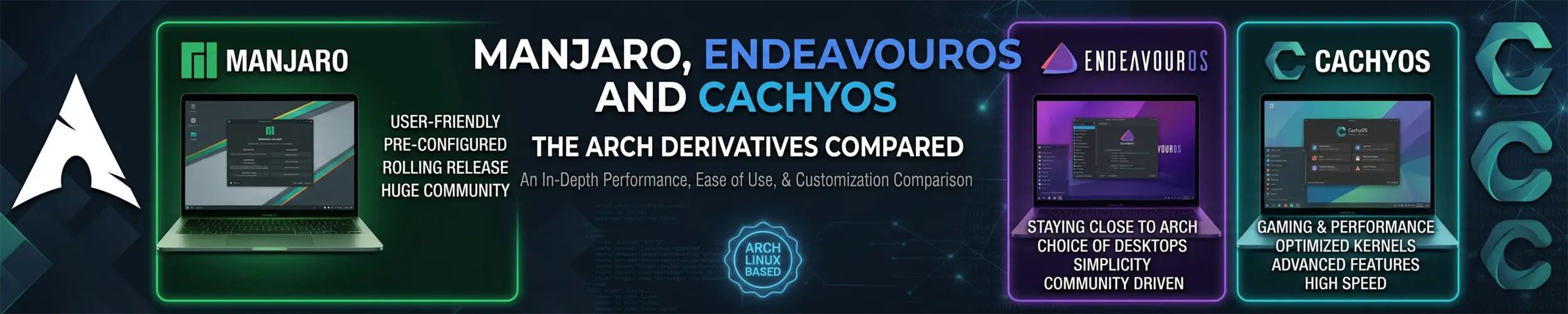
Arch is excellent and its installation process is a deterrent. The derivatives all solve that same problem — a graphical installer, sensible defaults, a desktop that works on first boot — and then diverge on a question that sounds technical and turns out to determine everything about living with them.
The question that actually separates them
Does it use Arch’s repositories, or its own delayed copy of them? Manjaro holds packages back — they pass through its Unstable and Testing branches before reaching Stable, roughly a couple of weeks behind Arch. EndeavourOS and CachyOS point straight at Arch’s own mirrors and add one small repository of their own on top. This single difference decides how current you are, how well AUR packages behave, and whose advice applies to your machine — and it is the thing to check first about any Arch derivative, including ones not listed here.
The reason it matters so much is the AUR. Build scripts in the Arch User Repository are written and tested against current Arch packages. On a system running two-week-old libraries, an AUR package that expects the newest version can fail to build or, worse, build and then break. Manjaro’s own documentation is blunt about the consequences, which we will come to.
Side by side
| Manjaro | EndeavourOS | CachyOS | |
|---|---|---|---|
| Packages from | Own delayed repos | Arch, directly | Arch, plus optimised overlays |
| Behind Arch by | ~2 weeks | Nothing | Nothing |
| Installer | Calamares | Calamares | Own installer |
| Desktop | Several official editions | Many, offered at install | Many, offered at install |
| Its own additions | Kernel manager, hardware detection, Pamac | A small repo, a welcome app | Optimised packages and kernels |
| Arch’s advice applies | With care | Yes | Mostly yes |
Manjaro
The largest and the most opinionated. The current release is 26.1, “Bian-May”, from August 2026, shipping GNOME, Plasma and Xfce editions and offering current, LTS and older-LTS kernels through its own kernel manager — which is genuinely one of the nicest pieces of software any distribution here has built. Its hardware-detection tooling is the other real contribution.
The branch model is Unstable (synced with Arch several times a day) → Testing → Stable, with Stable packages having had “roughly a couple of weeks testing” by users of the earlier branches. Updates then arrive in batches rather than continuously, which many people prefer.
Worth being precise about one widely-repeated claim: AUR support is not enabled by default. Manjaro’s own wiki says it must be switched on manually in Pamac’s preferences — so the criticism to make is not that it is on, but what the same page says once it is: “Use the AUR at your own risk!” and “No support will be provided by the Manjaro team for any issues that may arise relating to software installations from the AUR.” It is one toggle away and explicitly unsupported when you flip it. If you intend to use the AUR heavily, that combination is a reason to look at the other two.
And the criticism that will come up if you ask anywhere: Manjaro has repeatedly let TLS certificates on its own infrastructure expire. The most recent confirmed instance was the wildcard certificate for its main site expiring in November 2025, taking the site down for under three hours before a new certificate was issued. It is a small operational failure rather than a threat to your machine, but it has happened more than once, and for a project distributing software it is a fair thing to weigh.
EndeavourOS
The thinnest layer over Arch, and the easiest to describe: a Calamares installer, a small welcome application, one modest EndeavourOS repository, and otherwise Arch. Its shipped pacman.conf settles the question — core, extra and multilib all point at Arch’s own mirrorlist, with a single endeavouros repository alongside.
The current release is “Titan Nova”, from August 2026, a maintenance release ahead of a larger one — hardware-support updates, keyboard configuration fixes and improved Nouveau handling for NVIDIA cards. Notably, the Budgie desktop has been temporarily removed pending upstream Wayland work, which is exactly the kind of detail to check before assuming your preferred desktop is on the ISO.
Practically, this is what most people mean when they say they want “Arch, installed for me”. Arch’s wiki applies without translation, AUR packages behave as their authors intended, and Arch’s news announcements are yours to read.
The corollary is that it is Arch-shaped in the ways that matter: it expects you to read before you update, and nothing will stop you breaking it.
CachyOS
The performance-oriented one, and it is more specific than that phrase usually implies. Two concrete things:
Packages compiled for newer instruction sets. CachyOS builds its repositories for x86-64-v3, x86-64-v4 and a Zen 4 target, with link-time optimisation. Its own documentation claims a 5–20% uplift for the v3 tier over baseline x86-64. These repositories sit above the standard Arch ones in pacman.conf, so you get an optimised build where one exists and the ordinary Arch package where it does not — which is a neatly conservative arrangement.
Kernels with alternative schedulers. The project offers BORE, sched-ext, BMQ and real-time variants alongside CPU-optimised builds — not one blessed scheduler, but a menu.
Releases are named by month rather than versioned, arriving roughly monthly. The honest caveat: on ordinary desktop work you are unlikely to feel the difference, and the v4 and Zen 4 tiers require hardware that supports them. Choose it because you want the tuned kernels and the option of the optimised builds, not because you expect a transformation.
Garuda, and the rest
Garuda is active — datestamped releases through 2025 and 2026, its own browser build, an engaged forum. It ships Btrfs with automatic snapshots by default, which is a real safety net on a rolling distribution, wrapped in a visual style that people either love or find exhausting. If snapshots are the appeal and the theming is not, note that you can configure Btrfs and snapshots yourself on any of the others.
For anything else calling itself Arch-based, apply the test from the top of this page: look at its pacman.conf. If core and extra point at Arch’s mirrorlist, you have Arch with an installer. If they point somewhere else, you have a distribution whose maintainers now stand between you and every update — which can be a feature, but you should know which one you bought.
Two things that apply to all of them
The AUR is not audited, and this is not theoretical. Arch published a security announcement about malicious AUR packages in June 2026, and Garuda posted its own advisory about a further wave in August. The AUR is enormously useful and the review that stands between a package and your machine is you reading the PKGBUILD before you build it. That advice has always been given; it is now given with examples.
Read the Arch news before a large update — on EndeavourOS and CachyOS directly, on Manjaro a couple of weeks in advance of it reaching you. As a concrete example of why: Arch announced in December 2025 that the NVIDIA 590 driver drops support for Pascal and older cards and that the main packages switch to the open kernel modules. On any of these distributions, finding that out after the update rather than before is the difference between a decision and an incident.
Who should run which
EndeavourOS, if you want Arch and simply do not want to do the manual installation. It is the closest to the real thing, every piece of Arch documentation applies, and there is no third party in the update path.
Manjaro, if you would rather updates arrived in tested batches than continuously, and if the kernel manager and hardware detection appeal. It is the friendliest of these to someone new to Arch-style systems, provided you accept that you are on Manjaro rather than on Arch, and that the AUR is officially unsupported.
CachyOS, if you want the tuned kernels and optimised packages and have hardware that can use them — gaming and compilation are where people report actually noticing.
None of them, if you want a machine that does not change unless you decide it should. Every distribution on this page is rolling, and a rolling system asks something of you every few weeks forever. If that sounds like a chore rather than a hobby, Mint or Debian will serve you far better, and choosing one is not a step down.
And none of them for a server. Rolling releases on a machine you rely on and rarely look at is how you discover a broken update three weeks late — Debian or Rocky exist for that.
Related reading
- Arch Linux — the original, and what these are wrapping
- Linux Mint — if you wanted “it works” rather than “it is current”
- How packages and dependencies work — why mixing repositories causes trouble
- Package management — pacman in practice
- Gentoo — the other route to packages built for your machine